


The Evolution of Aviation: From Ancient Dreams to Modern Aircraft
For thousands of years, humanity has looked toward the sky with a single ambition: to fly.
Long before modern airplanes crossed continents in a matter of hours, inventors, philosophers, and dreamers were fascinated by the flight of birds and sought ways to imitate it. Their experiments—some successful, others ending in spectacular failures—laid the foundation for one of the greatest technological achievements in human history.
Today, aviation connects the world, transports millions of passengers daily, and operates with an extraordinary level of safety and efficiency. Yet this remarkable industry began with simple ideas, courage, and relentless innovation.
The First Attempts at Human Flight
One of the earliest known pioneers of aviation was Abbas Ibn Firnas, an Andalusian inventor and scholar born in the 9th century. Around the year 875, he constructed a pair of wooden wings covered with silk and feathers and launched himself from an elevated position near Cordoba.
Historical accounts suggest that he remained airborne for several seconds before crashing during landing. Although the flight ended unsuccessfully, Ibn Firnas demonstrated a revolutionary concept: controlled human flight might be possible.
More than a century later, the English monk Eilmer of Malmesbury attempted a similar flight, reportedly gliding hundreds of meters before landing. Like Ibn Firnas, he lacked one critical feature—a tail for stability and landing control.
These early experiments proved that flight required more than wings alone; it demanded a scientific understanding of aerodynamics.

Leonardo da Vinci: A Visionary Ahead of His Time
During the Renaissance, Leonardo da Vinci studied birds extensively and produced detailed sketches of flying machines.
His most famous concept, the Ornithopter, attempted to replicate the flapping motion of bird wings. Although none of his designs were built during his lifetime, Leonardo correctly recognized an important limitation: human muscles alone could not generate sufficient power for sustained flight.
His observations inspired future generations of inventors and marked the beginning of a more scientific approach to aviation.

The Birth of Aerodynamics
The true foundations of modern aviation emerged during the nineteenth century.
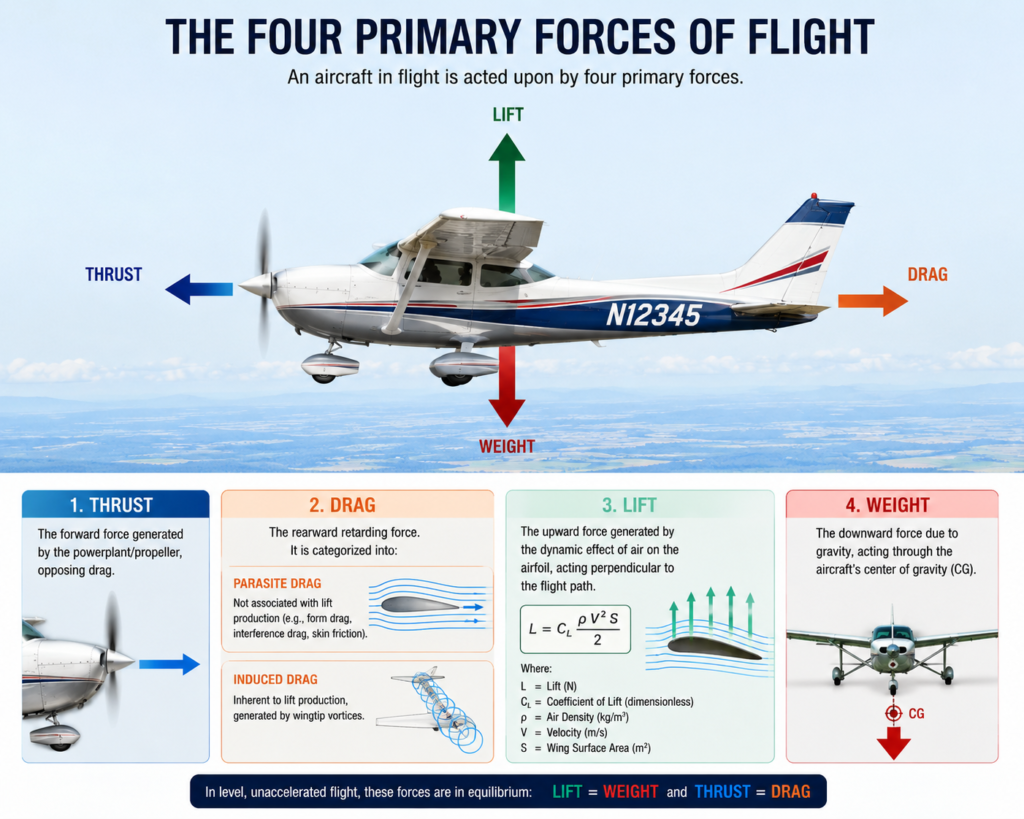
Among the pioneers was Sir George Cayley, often referred to as the “Father of Aerodynamics.” Unlike many inventors of his era, Cayley approached flight scientifically. He identified the four fundamental forces acting on an aircraft:
- Lift
- Weight
- Thrust
- Drag
More importantly, he proposed the basic aircraft configuration still used today: fixed wings for lift, a separate propulsion system for thrust, and dedicated control surfaces for maneuvering.
His work transformed flight from a dream into an engineering challenge.
The Race to Build the First Airplane
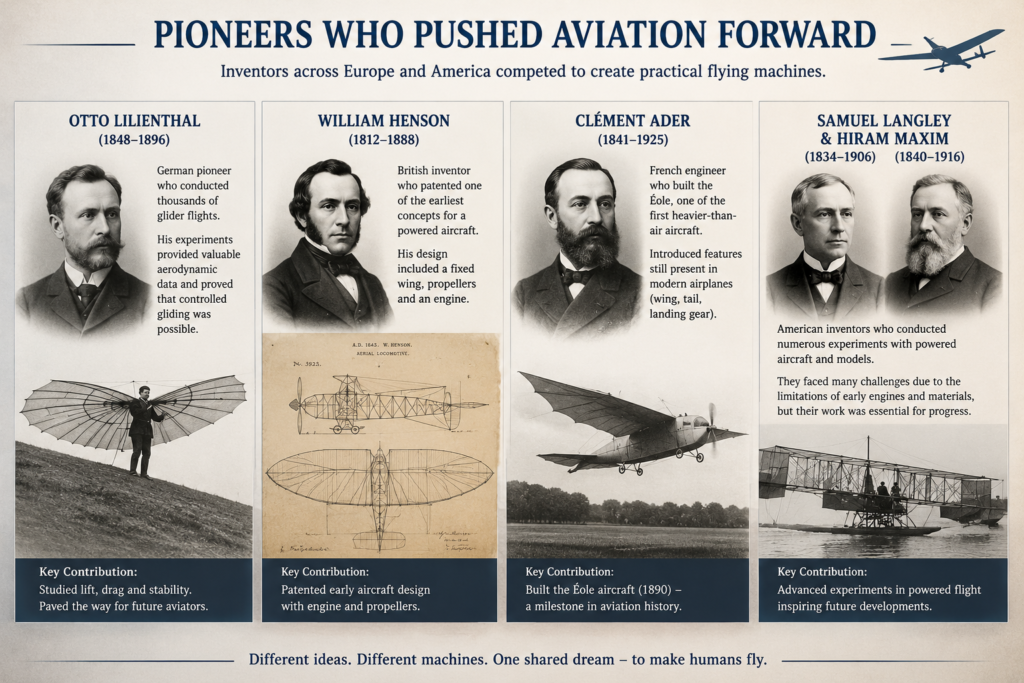
As technology advanced, inventors across Europe and America competed to create practical flying machines.
Notable contributors included:
- Otto Lilienthal, whose glider experiments provided valuable aerodynamic data.
- William Henson, who patented one of the earliest powered aircraft concepts.
- Clément Ader, whose Éole aircraft introduced several features found on modern airplanes.
- Samuel Langley and Hiram Maxim, who experimented with powered flight despite the limitations of early engines.
Each pioneer contributed knowledge that pushed aviation forward.
The Wright Brothers and Controlled Flight
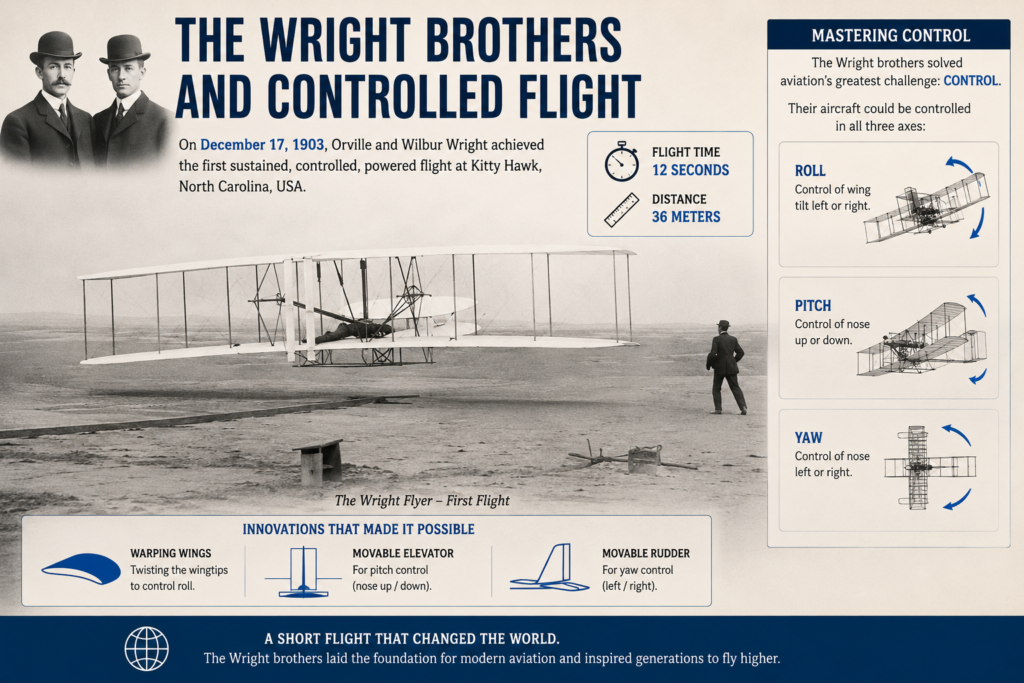
The breakthrough came on December 17, 1903, when Orville and Wilbur Wright achieved the first sustained, controlled, powered flight at Kitty Hawk, North Carolina.
While their flight lasted only 12 seconds and covered 36 meters, its significance was enormous. The Wright brothers successfully solved aviation’s greatest challenge: control.
Their Flyer incorporated systems that allowed pilots to manage roll, pitch, and yaw, establishing the foundation for modern aircraft control.
This achievement accelerated aviation development worldwide.
The Rise of Commercial Aviation
The early twentieth century witnessed rapid progress.
In 1909, Louis Blériot became the first person to fly across the English Channel.
In 1914, the world’s first scheduled commercial flight connected St. Petersburg and Tampa, Florida.
Five years later, in 1919, KLM was founded and remains the world’s oldest airline still operating under its original name.
By the 1930s, airlines had begun connecting continents, transforming aviation from an experimental activity into a practical means of transportation.

The Jet Age Revolution
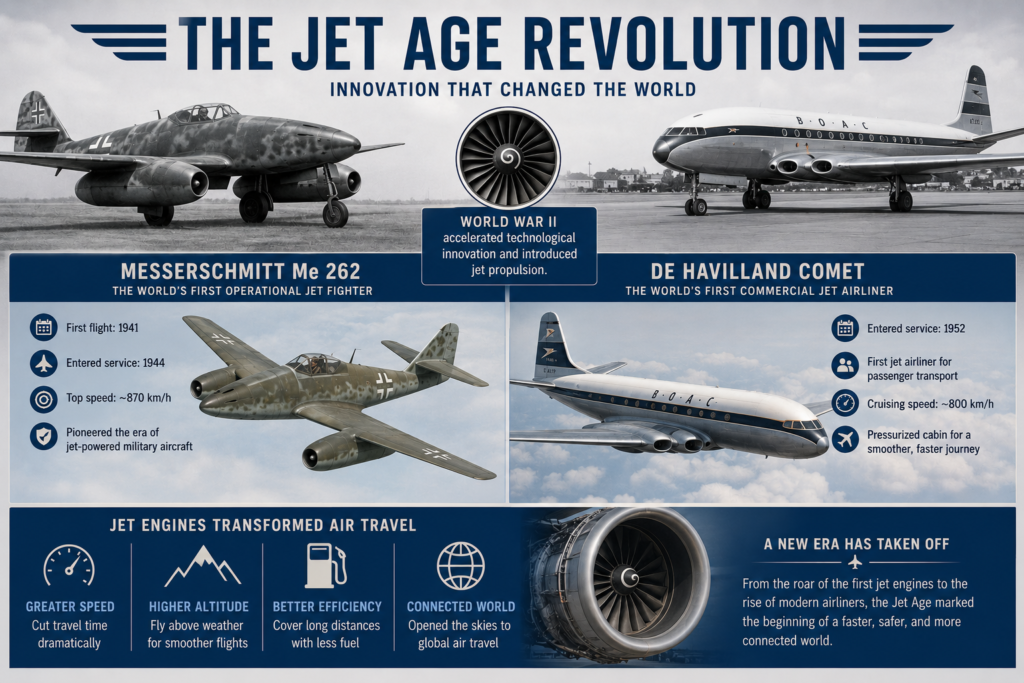
World War II accelerated technological innovation and introduced jet propulsion.
The German Messerschmitt Me 262 became the world’s first operational jet fighter, while the British De Havilland Comet entered service in 1952 as the first commercial jet airliner.
Jet engines dramatically increased speed, altitude, and efficiency, ushering in the modern era of air travel.
Breaking the Sound Barrier
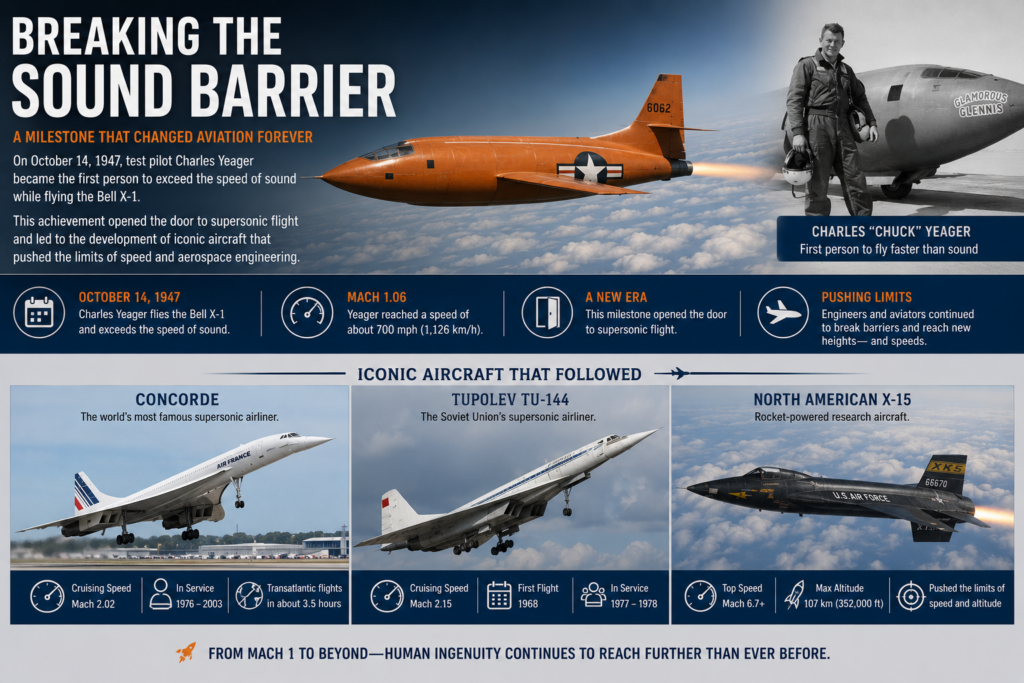
On October 14, 1947, test pilot Charles Yeager became the first person to exceed the speed of sound while flying the Bell X-1.
This achievement opened the door to supersonic flight and led to iconic aircraft such as:
- Concorde
- Tupolev Tu-144
- North American X-15
These aircraft pushed the limits of speed and aerospace engineering.
Aviation Today
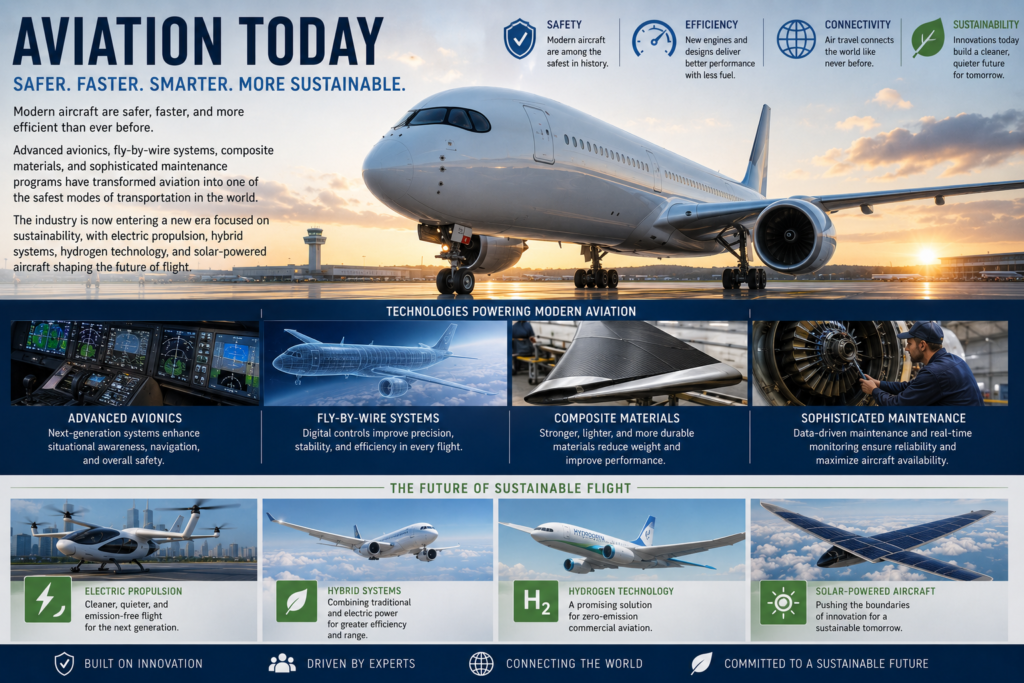
Modern aircraft are safer, faster, and more efficient than ever before.
Advanced avionics, fly-by-wire systems, composite materials, and sophisticated maintenance programs have transformed aviation into one of the safest modes of transportation in the world.
The industry is now entering a new era focused on sustainability, with electric propulsion, hybrid systems, hydrogen technology, and solar-powered aircraft shaping the future of flight.
Conclusion
The history of aviation is not the story of a single inventor or a single aircraft. It is the result of centuries of innovation, experimentation, and determination by countless pioneers.
From Abbas Ibn Firnas’ courageous leap in the 9th century to modern aircraft crossing oceans in a matter of hours, aviation continues to demonstrate humanity’s ability to turn dreams into reality.
And the journey is far from over.